
Complexities of changing kitchen cultures.

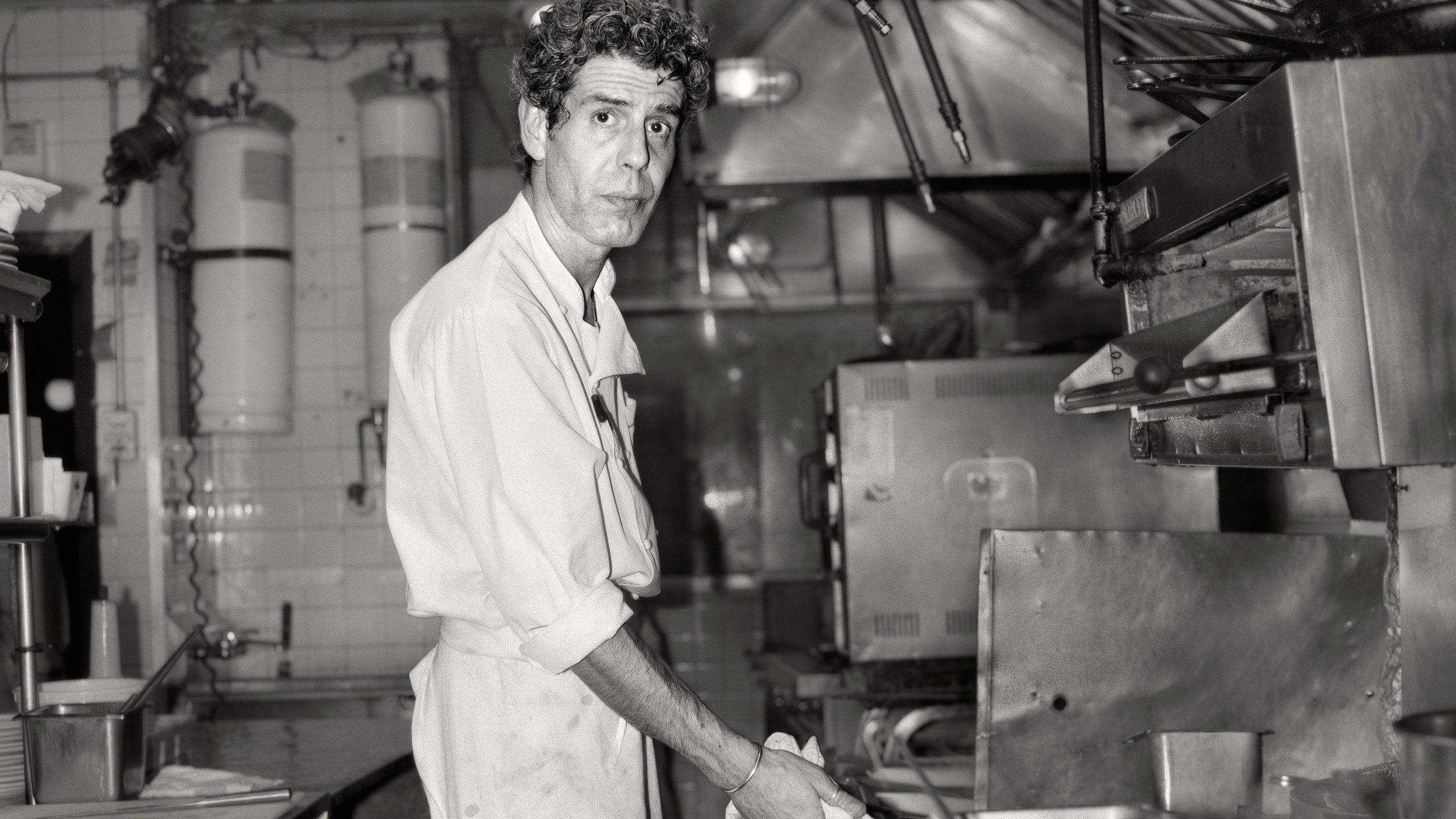
The toll which kitchen work takes on people is often far worse than what any paycheck can compensate for. Even those who become international superstars are sometimes hunted onto death. In Kitchen Confidential Anthony Bourdain described the following scenario.
My friend had worked for me for years, and had, at various times, caused me much grief and frustration. Since becoming a chef in his own right, however, he’d taken to calling me at intervals —to apologize for his past bad acts, telling me that when faced with managerial problems of his own involving personnel, or “human resource difficulties,” he’d seriously regretted the pain and worry he had caused me.
Now he knew, you see. He knew what it was like to be a leader of cooks, a wrangler of psychopaths, the captain of his own pirate ship, and he wasn’t liking that part of the job very much. Now somebody was dead and there was, inarguably, a causal relationship between the event of the troublesome cook’s firing and his death by his own hand.1
There are several entwined points which I want to explore here. To frame these I begin with the double role of Kitchen Confidential as presenting a picture of life within restaurant kitchens as they had existed in the late 20th century while also turning that picture into a template which kitchen cultures have been shaped by since then. It is a case of expectations being formed by what has become normalized and those expectations in turn further normalizing such behavior and a picture of what to expect in the future. Kitchen Confidential solidified a particular image of culinary futures in the mind’s of many restaurant workers. It is not that Anthony Bourdain or his book are alone responsible for making kitchen cultures worse. Rather it is that Kitchen Confidential has become particularly potent with cultural memory and laden with potential to continue shaping assumptions about the future of food. The norms and expectations go way back through the labyrinths of culture into the depths of the history of servants and slaves. Those deeper histories of where restaurant norms came from are somewhat excavated in this post and this one.
One point which I wish to suggest is that the realities of what restaurant-workers have to face each day is largely defined by global cultural tendencies and so are as complicated as any other global phenomenon. Another is that people’s assumptions about each other is key to how kitchen cultures perpetuate themselves, and so changing assumptions and habitual ways of perceiving and interpreting each other can affect cultural patterns. I also want to explore the possibility that valuing the subjective experiences and emotional wellbeing of food workers points to better ways to organize kitchens in non-capitalist culinary projects, suggesting that the creative engagement of the actual cooks making the meals, rather than just of the chef who made the menu, can improve not only the lives of cooks but also the experience of eating in public, and of food systems broadly conceived.
This next passage is from Anthony Bourdain’s “So you want to be a chef commencement address,” which sort of concluded Kitchen Confidential.
Assume the worst. About everybody. But don’t let this poisoned outlook affect your job performance. Let it all roll off your back. Ignore it. Be amused by what you see and suspect. Just because someone you work with is a miserable, treacherous, self-serving, capricious and corrupt asshole shouldn’t prevent you from enjoying his company, working with him and finding him entertaining. This business grows assholes: it is our principal export. I’m an asshole. You should probably be an asshole, too. (339)
Many of the norms of restaurants which Bourdain celebrated in his contradiction-affirming way are things which I would like to change. I like his advice to be amused by what you see in your co-workers. There generally is a lot to be amused by. But it’s not all about people behaving like rectums. It could be the case that perceiving people as treacherous and miserable leads to people being like that, especially if we keep in mind each person’s sense of selfhood is shaped by how other people perceive them and how the interpretations of those other people are conveyed through interactions.
With this in mind it can be understood how choosing to perceive co-workers generously can be an act of comradery which counters authoritarian styles of perception. In some cases this can also help to protect one’s self from the cooks, for example, who have sunk into such pits of miserabilism that they perpetually curse at pans and stoves as if they were personally responsible for burning them or conspiring to make a dish turn out problematically. This often makes me empathize with these cooks crushed by the restaurant industry. As with any case of having to interact with someone who refuses to face their own problems, instead sending their emotions outwards as shock waves that reverberate, such patterns take their toll on everyone in the wake of such turbulent psychological waters. Sympathetic interpretations of such patterns can change the annoyances of workdays into nodes of solidarity.
2
How have kitchen cultures become so similarly problematic all around the world? In his 2018 afterword, Bourdain wrote,
“Though I believed when I wrote this book that I was writing it for a small group of restaurant insiders in the New York tri-state area, everywhere I went —whether Melbourne, Portland, Singapore or San Sebastian —I’d hear from cooks a similar refrain: “Dude, you wrote my life!”
“And believe me, that feels good. I had no idea when I put the words to paper —in the early morning hours before going to work —that people from as far away as New Zealand would be asking me about “this fish on Monday thing.” Or that “this thing of ours” —the subculture of cooks —was so international. Everywhere I went, I found that uniquely damaged look in the faces of the cooks I met —the expression of a person who has been disappointed many times —and expects to be again —but who cannot help but continue to live in hope.” (355, afterword)
How is it that the similarities within the international subculture of cooks in all these diverse places outweighs the wider societal differences? How is it that the physical spaces and organizational patterns of restaurants grow such a seemingly uniform international subculture? One way to approach this question is to look at the similarity of the tools of the trade, from knives to stoves, fridges, and stainless steel tables. Restaurant equipment is supplied by increasingly consolidated companies, making professional kitchens into increasingly uniform spaces. And then there is the question of what is taught in cooking schools around the world, which I don’t intend to write about. On another level, it is worth considering to what degree these culinary cultural currents are a New York-ification of the restaurant industry. As Bourdain wrote, he was presenting a specifically New York version of “The Life.” When his narrative became a template, this New York version of what restaurant work is like became the expectation and the norm for restaurants all over the world. The New York version of the life was, of course, enmeshed with the ways in which culinary labor practices had developed elsewhere. And the New York-ification of restaurants also has a deeper history. A case can be made for saying that the urgency of getting meals to diners as quickly as possible has its origins in the chop-houses and oyster bars of 19th Century New York. French restaurants of the 19th Century mostly emphasized leisurely meals served with ample time to enjoy wine and savor flavors. The idea was to dine as if you were an aristocrat who had all the time in the world. New York seems to have given birth to the hurried business lunch and expectations that all restaurant meals should be quickly manifested.
Another remarkable point of the passage is “the uniquely damaged looks in the faces of the cooks” who Bourdain met in his travels. Partly, this is connected to the reality of how more orders emerge out of the chit-printer, just when cooks begin to believe the rush is over and there might be time to take a break or start shutting-down. This is again a matter of how the tools and technologies of restaurants become part of the extended minds of cooks. Many cooks I’ve worked with have said that they often hear these printers making demands even in their dreams. The damaged looks in the faces of cooks are partly reflections of the various types of backgrounds of people who end up working as cooks. Often cooks have had tumultuous early life histories and so feel at home in hectic kitchens.
3
Turning now to the to questions of how the lives of cooks and global culture could be improved through changing how creativity is thought of and valued, it can be helpful to ask, what does it mean to be creatively engaged while working? Why is it assumed that only one person in a kitchen can be creative? Versions of creative engagement or artistic mindset which I have in mind are an assertion of the worth of each person as an animated nexus of interconnected reality, uniquely positioned to creatively interpret and engage with each moment of life as it is encountered. This weaves in another thread: that affirming one’s own creative freedom —with this conception of interconnected reality in mind —means affirming the creative freedom of all people.
Living an artistically engaged life is not exclusively a matter of creating works of art that ever get recognized as such. Many installation artists have played with this theme, celebrating artifacts of daily life while challenging the idea that artists are cut of a different cloth than other humans. Living artistically can be simply styles of perceiving and interacting with the world. Within kitchens, these versions of artistic living are less about creating new dishes and more about the care that goes into developing knife skills, fine-tuning senses, and all that is involved in becoming experienced — so long as this is all done with a style of perceiving and experiencing that is considered artistic at least by the practitioner. This is an entirely subjective measure which makes each person the highest authority on whether their own ways of perceiving and experiencing are artistic or not. As such, each person’s artistic life consists of their own patterns of fluctuating between artistic styles of existing and all their other ways of perceiving and experiencing.
Food historian Ken Albala, in a lecture called, “Is food art?” looks at what the qualifications could be for considering food as art. He sees cooking as art in those situations in which the cook is not constrained; where there is license to combine ingredients and employ techniques that are a direct reflection of the individual’s creative energies; where the cook gets pleasure from the tasks, gets to express ideas, put feelings and emotions into things —channeling it all through their hands into the things that are prepared. He argues that this is much more likely to happen in the home kitchens of ordinary people than in restaurant kitchens where cooks are poorly paid, continually yelled at, and generally unthanked.
4
The celebrity-chef phenomenon which shifted into a new phase in the 90s and early 2000s celebrated the authoritarian position: that cooks must do everything exactly as the chef dictates and respond to all orders with “Yes, CHEF!” I haven’t watched much from the worst of chef-shows such as Hell’s kitchen, and don’t intend to. Gordon Ramsey would seem to occupy the central place in shouting this mastery of chefs over their workers into the global semiosphere. In comparison Anthony Bourdain is mild, but still adamantly in favor of chefs being tyrants.
“What people don’t get about professional-level cooking is that it is not about the best recipe, the most innovative presentation, the most creative marriage of ingredients, flavors and textures; that, presumably, was all arranged long before you sat down to dinner. Line cooking —the real business of preparing the food you eat —is more about consistency, about mindless, unvarying repetition, the same series of tasks performed over and over again in exactly the same way. The last thing a chef wants in a line cook is an innovator, somebody with ideas of his own who is going to mess around with the chef’s recipes and presentations. Chefs require blind, near-fanatical loyalty, a strong back and an automaton-like consistency of execution under battlefield-like conditions.”2
One of the many frustrating things about working as a line cook is that the creativity required to do the job well is often disallowed. Cooks are faced with having to make each menu item exactly as the chef designed it while having to adapt to all the variations that come up. Any uniqueness in a cook’s interpretation of a menu item is generally discouraged. This has demoralizing effects in more ways than one. It lessens morale, in the sense of enthusiasm, but also ‘moral’ in the sense of conscience. When workplaces force people to perpetually go against their own judgement, to mindlessly follow orders, it becomes habitual to ignore any sense of conscience or independent sense of discernment at all.
By independent sense of discernment I mean the ability to solve practical problems without being told how to do so and the ability to assess what should be done next on a case by case basis. When the processes of engaging these abilities with situations that arise are interfered with through being made to doubt every little decision, through micromanaging chefs or other co-workers imposing their sense of discernment over others, there is psychological damage done, and quite possibly neurological damage, as one worker’s miraculous ability to interpret their surroundings is broken by another worker insisting that the only thoughts that matter are those of the person who is in a position of authority. With age, such situations feel more injurious. When you already have tried-and-true ways of dealing with types of situations and you are told that you have to do something in a way that fails to make sense to you it feels like there are trees being felled in your neurological forest. Though I have no doubt that for neurological health it is very good for old dogs to learn new tricks, it must also be healthy to be free to activate mental patterns that allow for practiced talents to click and evoke processes of going from one movement and decision to another without being made to grind to a halt at every step so that someone else can assert their authority.
Most food work jobs, in both front of house and back of house, involve having a quickly changing list of tasks in mind. For servers this can be things like, “I have to take a drink order from table 205, then clear plates from 302, then 202’s food should be ready to pick-up. . .” For cooks it is much the same, though often at a faster pace and concerning finer details. “Sauté pancetta in these two pans, drop two orders of linguini in the water, plate these three dishes that I’m finishing now, then take the salmon out of the oven . . .” There are always new tasks being thrown into the mix and a sort of triaging logic for prioritizing what to do next. New orders are continually coming in, second courses are getting via-ed, timing between cooks is constantly being re-negotiated. That’s the nature of the beast. As long as it happens in ways that allow each worker to be in control of how they go from one task to another and everyone is relatively respectful there can be fulfilling feelings of being an integral part of an impressive team. But when someone insists on constantly interrupting the flow of how other workers prioritize, always telling people that they are doing something wrong and micromanaging every little detail, it shatters the neurological processes involved —or at least that is how it feels to me.
Authoritarian leadership styles often involve perception styles which look for the worst in people, the worst of whatever category they may contain their image of you within. When the message received from an authority figure is that they are perceiving you as incapable of thinking for yourself it shapes your sense of self and your sense of what is possible. Some people burn with defiance when perceived in this way, eager to prove their worth. Others doubt themselves to the point of no longer believing in their own capability to solve any kind of problem.
When people are micromanaged to such an extent of being made to doubt their ability to solve even minor problems, their general sense of empowerment erodes away into a perpetual assumption of powerlessness. This is one of the many problems of prioritizing efficiency above all else. Moments of being made to doubt themselves while in the process of solving a problem shape the confidence, physical health, and general well-being of workers for years just so a business can maximize profits which often vanish as quickly as the economic wind changes direction.
Disbelieving in the authority of someone who tries to dominate can have a protective effect compared to when young people fresh from cooking school —fully believing in the “Yes Chef!” mentality —end up in tears after a chef verbally bites their head off. But thinking about how things could be done differently if equality and the dignity of each person were respected can make moments of feeling seen as less than equal sting even worse, especially when these experiences repeat and become a pattern or a policy.
The disengagement of anyone’s mind that has to happen to mindlessly follow orders is psychologically and culturally damaging. When this becomes a habit, harm is done not only to that one mind-numbed being but also to the culture they are part of, the wider nexus of relationships connected to that person —including whoever eats the food they mindlessly prepare. This micromanagement is an explicit formula with fast food chains but it also exists in fine dining restaurants, rustic-bougy retreat centers, and anywhere that efficiency is valued over the mental health of workers.
In my experience it has rarely been head-chefs who have made kitchens feel like authoritarian spaces, but other cooks —especially recent graduates of cooking schools, who often seem to believe that part of their job description includes instilling firmly hierarchical mentalities and unquestioned obedience to authority figures in the minds of their co-workers. This secondary authoritarianism often creates what I call a Stalinist work environment, were everyone feels pressured to point out the rules of the boss and there is a general sense that any variation from those rules will result in getting ratted out. In contrast, the rapport that develops with cooks who for whatever reason have developed cooperative egalitarian ways of interacting with co-workers makes shifts feel so much more fulfilling than when working with people who continually talk-down, criticize, and micromanage. In the past ten to fifteen years it has seemed less common to encounter these gem-like cooks who understand the power of working together as equals. The cooks who are willing to help out a swamped co-worker without having to be told to do so tend to be ones who also complete tasks with an artistically engaged sense of things and who understand that for other people to creatively engage their own sense of things means to do it in their own ways.
5
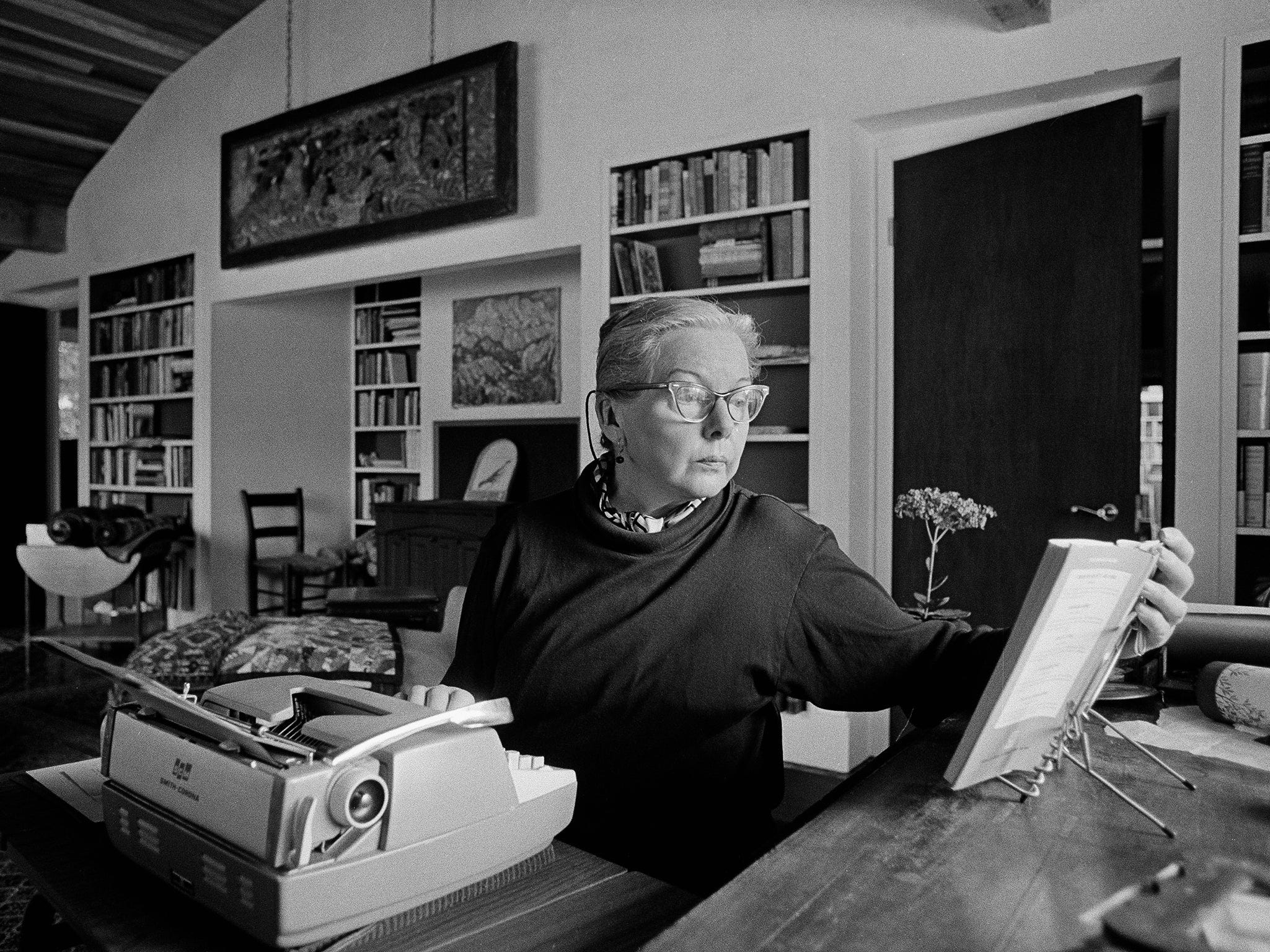
Consider the culinary aestheticism of food writers who generally think of pleasures of the senses as key to a good life. Eating is considered an art that is mastered through fine-tuning one’s sense of taste. Though these concerns can seem frivolously snobbish, many bleak moments of life are lightened by taste sensations —not for the nourishment which any meal could provide but for taste’s sake alone. Part of the pleasure of tasting something amazing is a feeling of good fortune that accompanies such moments.
Attention to senses can also be a matter of spreading attentiveness to what is perceived so as to be mindfully considerate about everything and everyone in the space. It can be quite difficult to remain peacefully mindful in hectic kitchens but when cooks are feeling confidently tuned-in to the complex multitasking timing of having several pans over hot flames in which ingredients are quickly approaching the thin golden-brown line between under-done and burnt, other things in ovens, and a bustling building’s weight of pressure pouring down upon them —there are many joyful moments of being intuitively in tune with everything that is happening in all the pans and ovens, of knowing exactly the right moment to deglaze a pan, to flip scallops, or to do any of the other ten thousand things. This “gathering all we are into one desperate effort to see and touch” (as Walter Pater wrote of aesthetic engagement) is a key aspect of what makes restaurant meals impressive. It is also one way in which working as a cook can be conducive to living both artistically and mindfully. In addition to the athletic attunement of senses involved in all these dance-like movements, there is an element of being like a musician whose performance offers a unique interpretation of someone else’s artistry.
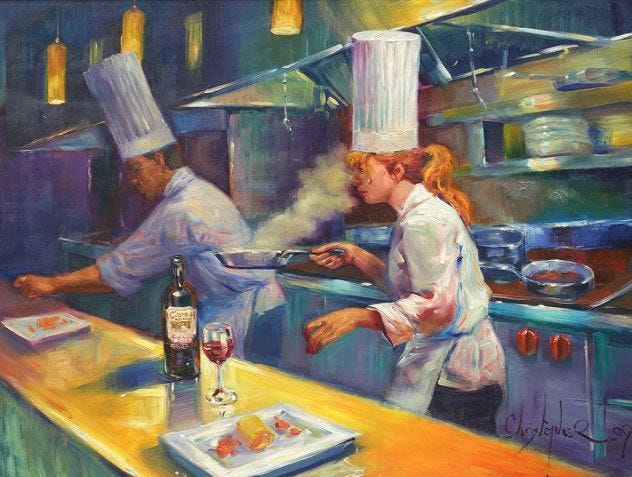
For foodies to fully enjoy the art of eating, they should perhaps consider what Walter Pater was saying when he said, “to find, not [beauty’s] universal formula, but the formula which expresses most adequately this or that special manifestation of it, is the aim of the true student of aesthetics.” To achieve this aim, the uniqueness of each manifestation of a dish should be celebrated, not so much the original idea to combine certain ingredients. As Ralph Waldo Emerson wrote, “A foolish consistency is the hobgoblin of little minds, adored by little statesmen and philosophers and divines.”
Most restaurant dishes are completed through the efforts of cooks. A chef may have taught them how to do each task involved in creating a menu item, but teams of cooks, or solo cooks, then do each of those tasks and present the final product. Whether it is a beautiful thing that then gets eaten or just a poorly realized good idea all depends on the attunement of cook senses. Though some chefs impressively express their region and all sorts of ideas through menus, in general, menu writing is often more like playing the stock market than anything. It is mostly a matter of having fingers on pulses, keeping up with trends, knowing what will sell and what ingredients can be used while keeping food costs down and kitchen efficiency maximized. The phenomenon of restaurants having menus has often been thought of as a democratic innovation but the result of this has been creation of expectations of uniformity. Being fed by this cookie-cutter expectation then contributes to expecting to see uniformity in the rest of life. Whatever else this does to people’s minds or bodies, it makes for a world where restaurant-goers eat stifled artistic impulses.
When cooks are yelled at for creating variation from expectations of uniformity the joy of creating beautiful things is lost. Oscar Wilde wrote that “The aim of art is to convey a mood.” Applied to food, perhaps this could make sense of the claims of many grandmothers that the secret ingredient is love? Perhaps the quality of a particular creation is connected to the emotions of the person who produced it? When a cook is enjoying the feeling of being in tune with their senses, at the top of their game, making every dish come out just right, the mood that is conveyed by those dishes is sometimes described as a transcendent experience. What emotions are conveyed through the artwork of a cook who is being yelled at and humiliated while preparing meals? Many restaurant visits have likely been spoiled by the taste of wilted self-esteem.
When a meal is made in a domestic kitchen, tasks are made more enjoyable through trying to make a dish a bit better than it was last time or to try a slightly different variation using additional or alternative ingredients. Experiments go wrong every so often. But even then, in the comfort of one’s own home there are the pleasures of learning from minor mistakes how to make a dish better in the future. In this way there is a kind of dialectical advancement in abilities, an attunement of senses.
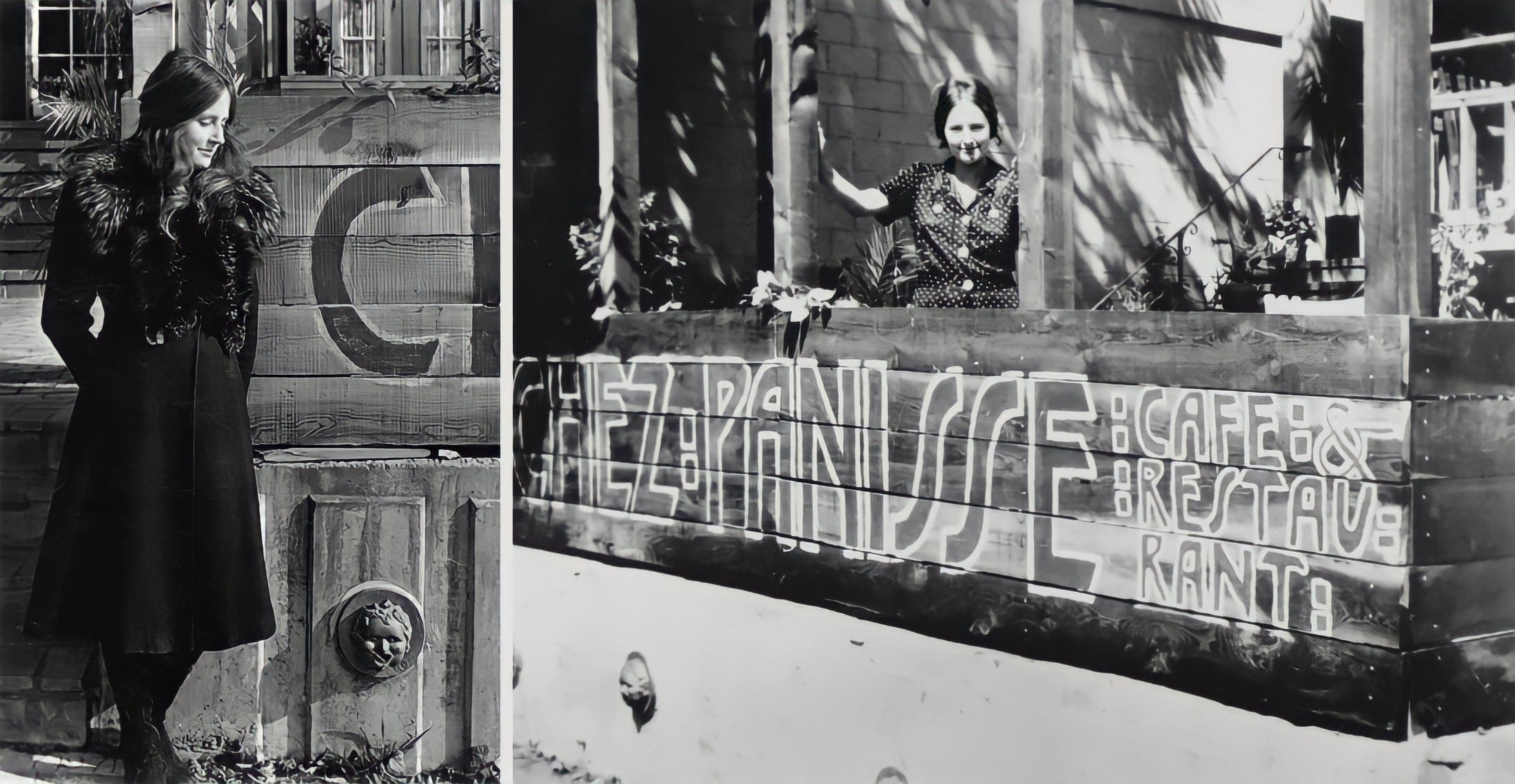
Attention to senses has been a prominent theme in the life and writings of Alice Waters, who titled her memoir Coming to my Senses, and often attributes the origins of her food-related activism to concern for the taste of ingredients. It was through that concern that she turned Chez Panisse into a trail-blazing restaurant in opening paths for farmers, activists, and other chefs to create alternative food networks to those of the industrialized food system. Her 2021 book, We Are What We Eat, is a manifesto that contrasts fast food culture, as defined by convenience, uniformity, availability, trust in advertising, cheapness, ‘more is better’, and speed; with slow food culture, as defined by beauty, biodiversity, seasonality, stewardship, pleasure in work, simplicity, and interconnectedness. She writes,
Culture is the invisible moral structure underneath us, guiding us all subconsciously and shaping everything we do. Fast food culture has dominated culture in the world.
This is happening because fast food culture, like all cultures, has its own set of values —what I call “fast food values.” Values determine the behavior, which ultimately creates the culture. If you’re eating in a fast food restaurant, or in a fast food way, not only are you malnourishing yourself, but you’re also unwittingly digesting the values of this fast food culture. Those values are a part of you —just like the food. And once those values are a part of you, they change you. You begin to have a different outlook on things, different cravings, different moral standards and expectations. Now your desires and hungers are being programmed by this fast food culture, and you may not even realize it; it’s subconscious. But nevertheless, your world starts to reflect the values you’ve ingested. You begin to accept those values as truths: that everything should be available to us all the time; that more is always better; that food should look and taste the same, no matter the season, wherever we are in the world; that time is money, and speed should be cherished above all else; that our choices, food-related and otherwise, have no consequences.
This is the soil that I feel all our other problems grow out of: fast food and its values. We need to examine the consequences of these fast food values so we know what we can do to change them.3
What Alice waters calls fast food culture has soaked into much of how people think about food and food-work generally. Taking the approach which she points to, emphasizing interconnectedness, and pleasure in work especially, makes it clear that the experience of workers should be honored more than profits or efficiency.
Micromanagement as the main technique of maximizing efficiency disfigures the minds of workers through internalization of the sentiments involved in saying, “I just work here, I don’t make decisions.” Something very problematic happens when workers believe that while working they surrender their rights to be in charge of their own minds, their own bodies. I see this as of importance not just for the well-being of separate workers, but for how global culture shapes itself, and how restaurant workers shape the psychologies of their co-workers and the future of food-work.
The world as it exists in each person’s mind contributes to how the world at large is experienced in global culture through how people convey glimpses of the world within their mind and glimpse the worlds within the minds of others as they interact with them (or taste or read their creations).4 When a person’s perceptions and interactions are strictly controlled by authority figures then the world creating possibilities of their minds are distorted, creating distorted visions of what is possible. This is one aspect of why prisons and factory farms are such grievous things, and why workplaces often feel like prisons and slaughterhouses of the soul. If perceptions shape a world within a mind and that world contributes to a shared sense of global culture, then global culture is reduced to visions of conveyor-belt cruelty when any person (any animal) is kept from interacting, interpreting, and perceiving freely. When restaurant workers are micromanaged, and are not able to resist the psychological effects of such patterns their minds get swept aside so the strictures of bosses can be obeyed to the letter. This makes all of world culture more mindlessly authoritarian.
To conclude, making culinary work more conducive to creative engagement though emphasizing skill development and the uniqueness of each manifestation of a dish, all in the context of respectful interactions and openness to the universal uniqueness of each mind, could make for healthier workplaces and more satisfying dining experiences. But this alone can only change one workplace at a time. For changes in global cultural patterns there needs to be more written about the complexities of these changes, more envisaging of alternatives accompanied by activism to make those changes happen, and more personal transformation of ways of perceiving, interpreting, and treating each other.
Anthony Bourdain. Kitchen Confidential: Adventures in the Culinary Underbelly. (2000) (2018 Bloomsbury edition) 281
Bourdain. Kitchen Confidential. 61 - 62
Waters, Alice. We Are What We Eat: A Slow Food Manifesto. Penguin Press. New York. 2021. 11-12